
From the first demonstrators to the new tidal farms planned for the Alderney Race (Raz Blanchard), the past twenty-five years have seen sea trials, industrial ambitions and hard lessons.
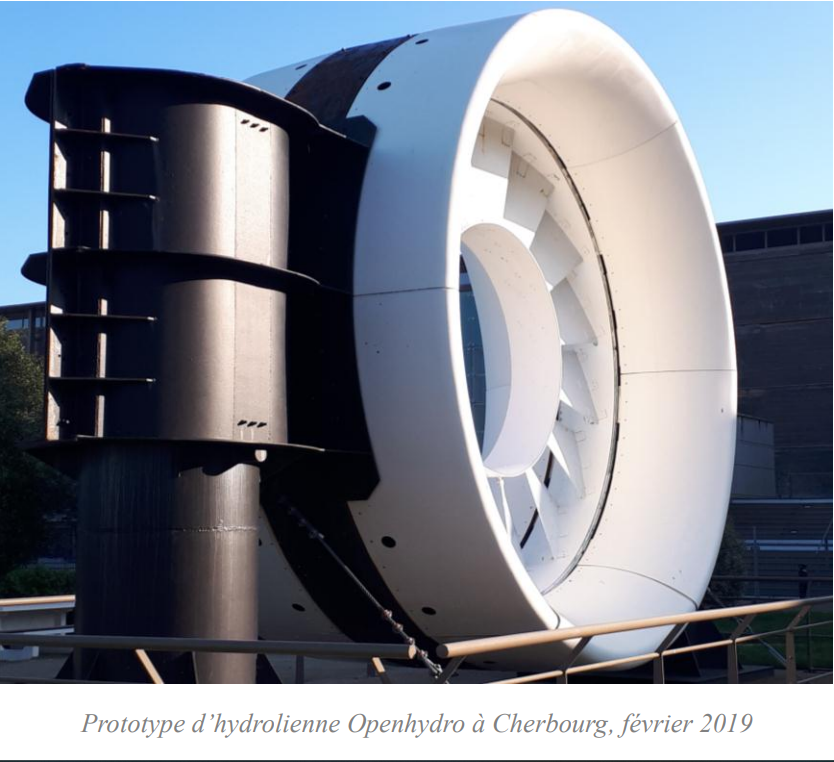
Cité de la Mer, Cherbourg, February 2019. Photograph © Olivier Juin.
Tidal currents are predictable. Yet bringing tidal turbines from demonstration trials into sustained commercial operation has proved harder than early announcements suggested.
What was built, what it cost and how it performed at sea are the starting points for this history.
Milestones
The pioneers
In the UK, Seaflow and SeaGen were early tidal turbine projects. In France, Sabella carried out its first trials in the River Odet. Research and current measurement campaigns were already under way. How to secure turbines to the seabed and maintain them was a concern from the outset.
Plans for commercial tidal farms
DCNS took a stake in OpenHydro in 2011. As more projects took shape in France, industry committed resources and ports developed infrastructure to support them.
Two major setbacks
The NEPTHYD project was abandoned after GE withdrew from its Oceade turbine technology. In 2018, Naval Energies ended its work on OpenHydro. The industry initially envisaged failed to materialise.
Further trials and setbacks
Trials continued with other technologies, including those developed by HydroQuest and Sabella. Despite its operating experience off Ushant (Ouessant), Sabella went into liquidation in January 2024.
A new phase in the Alderney Race
FloWatt and Normandie Hydroliennes are preparing new pilot farms. Consents, financing, tariff agreements, construction and the start of power generation are distinct milestones.
Lessons from experience
A successful turbine is only one part of a successful tidal farm. Actual annual generation, stability on the seabed, installation, maintenance, grid connection and eventual removal all need to be assessed for the farm as a whole.
A turbine’s availability tells us how often it is ready to operate. Its energy yield tells us how much electricity it produces.
The HydreManche approach
The idea behind HydreManche dates back to 2002. It centres on a shared foundation that can be ballasted to help transport, install and recover several turbines together. This approach is now the subject of patents for tidal and wind energy applications.
Further engineering studies and trials are needed to verify and quantify the technical and economic benefits.
Sources and approach
This account draws on a collection of press cuttings, industry publications and institutional documents assembled since the early 2000s. The milestones distinguish historical events from announced plans. A more detailed chronology with references may be added over time.
- Vivre EDF, no. 61, 2009, on tidal stream potential and numerical modelling of tidal currents.
- Ouest-France, 28 January 2011, “Hydroliennes : le choix de DCNS déçoit Sabella” (on Sabella’s disappointment at the choice made by DCNS).
- La Manche Libre, 8 August 2009, on Olivier Juin’s early work and initiatives.
- Industry statements and regional press coverage of NEPTHYD, OpenHydro, Sabella, FloWatt and NH1 (2017–2026).
Last updated November 2026.