
1. What the simulator shows
Tidal stream energy relies on a highly predictable resource: tidal currents. However, predictability does not mean constant production.
Current speed varies significantly during a tidal cycle, and also between neap-tide and spring-tide periods. The simulator helps visualise three essential points:
- instantaneous power depends very strongly on current speed;
- mechanical loads increase rapidly as the current accelerates;
- an installed capacity expressed in MW does not correspond to continuous production in MW.
Installing a 1 MW tidal turbine does not therefore mean producing 1 MW continuously. Actual production is measured by the energy effectively generated over time, expressed in MWh.
2. From current speed to recoverable power
The power available in a marine current mainly depends on:
- the density of seawater;
- the area swept by the rotor;
- the turbine’s power coefficient;
- and, above all, the speed of the current.
The simplified physical relationship can be written as:
P = 1/2 × ρ × Cp × A × V³
where:
- P is the recoverable power;
- ρ is the density of seawater;
- Cp is the turbine’s power coefficient;
- A is the area swept by the rotor;
- V is the current speed.
The key point is the presence of V³. A seemingly modest difference in current speed can lead to a very large difference in power.
For example, with comparable rotor area and technology, a current of 4 m/s contains eight times more kinetic power than a current of 2 m/s. This is why only the fastest sites can reasonably aim for industrial profitability, subject of course to installation, maintenance, grid-connection costs and operating conditions.
Power coefficient Cp
The Cp indicates the proportion of the current’s energy that is effectively converted by the rotor. It should not be confused with the total power available in the current, nor with the final electrical efficiency of the complete system.
The power contained in a marine current cannot be fully recovered by a tidal turbine. The rotor slows the water passing through it, but the fluid must still continue to flow downstream. A machine that completely stopped the current would no longer produce anything. This is why a power coefficient, noted Cp, is introduced.
This coefficient expresses the share of the current’s kinetic power that is converted into mechanical power on the rotor shaft, before losses in transmission, generator and power electronics. A Cp of 0.40 therefore means that approximately 40% of the power available across the rotor swept area is captured as mechanical power.
The classical open-flow Betz limit sets a theoretical ceiling of 59.3%. This is not the actual efficiency of an industrial tidal turbine, but an ideal physical limit. In practice, real machines operate below this level, often around 0.30 to 0.45 depending on rotor type, current speed, turbulence, blade setting and conversion losses.
3. Rated power, rated speed and rotor diamete
The rated power of a tidal turbine is the maximum power it can deliver under specified conditions. It must always be associated with a rated current speed.
A machine advertised as 1 MW does not have the same meaning depending on whether it reaches that power at 2.5 m/s, 3.5 m/s or 4.5 m/s.
To reach a given rated power at a lower current speed, it is generally necessary to increase the area swept by the rotor, and therefore the diameter or useful dimensions of the machine. This strategy can improve production during intermediate-current phases, but it also increases mechanical loads and structural dimensions.
Energy sizing cannot therefore be separated from mechanical sizing.
4. When production becomes a structural issue
The forces exerted by the current on a turbine and its supporting structure vary approximately with the square of the current speed.
F ≈ 1/2 × ρ × Ct × A × V²
where:
- F represents the hydrodynamic force;
- Ct is a thrust or drag coefficient;
- A is the exposed area;
- V is the current speed.
In very high-current areas, the challenge is therefore not only to capture energy. It is also necessary to install, maintain and remove machines capable of withstanding significant loads over the long term.
This is where the support architecture becomes decisive. A shared, stable, ballastable and recoverable structure can help reduce heavy offshore operations, mutualise certain functions and facilitate the operation of a group of machines.
5. Using current speeds from nautical documents
Tidal stream atlases and nautical documents often provide current speeds for reference conditions: mean neap tides and mean spring tides.
For educational purposes, it is possible to estimate the current speed corresponding to an intermediate tidal coefficient by interpolation between two reference values, for example:
V45: current speed at mean neap tide;
V95: current speed at mean spring tide.
The estimated speed for a tidal coefficient C can then be approximated by:
V(C) = V45 + [(C – 45) / (95 – 45)] × (V95 – V45)
This method makes it possible to connect the simulator to nautical data that can be understood by seafarers, engineering firms and decision-makers. It must, however, be used with caution: it does not replace site measurements or detailed hydrodynamic modelling.
6. From raw resource to exploitable site
A powerful current is not enough to define a good industrial site.
Feasibility also depends on:
- water depth;
- bathymetry;
- seabed conditions;
- turbulence;
- wave and sea-state conditions;
- installation and maintenance possibilities;
- distance to electrical grid connection;
- existing uses: fishing, navigation, easements and regulated areas;
- environmental constraints.
An exploitable tidal-stream site is therefore the result of a compromise between energy resource, mechanical constraints, intervention costs, grid connection and acceptability.
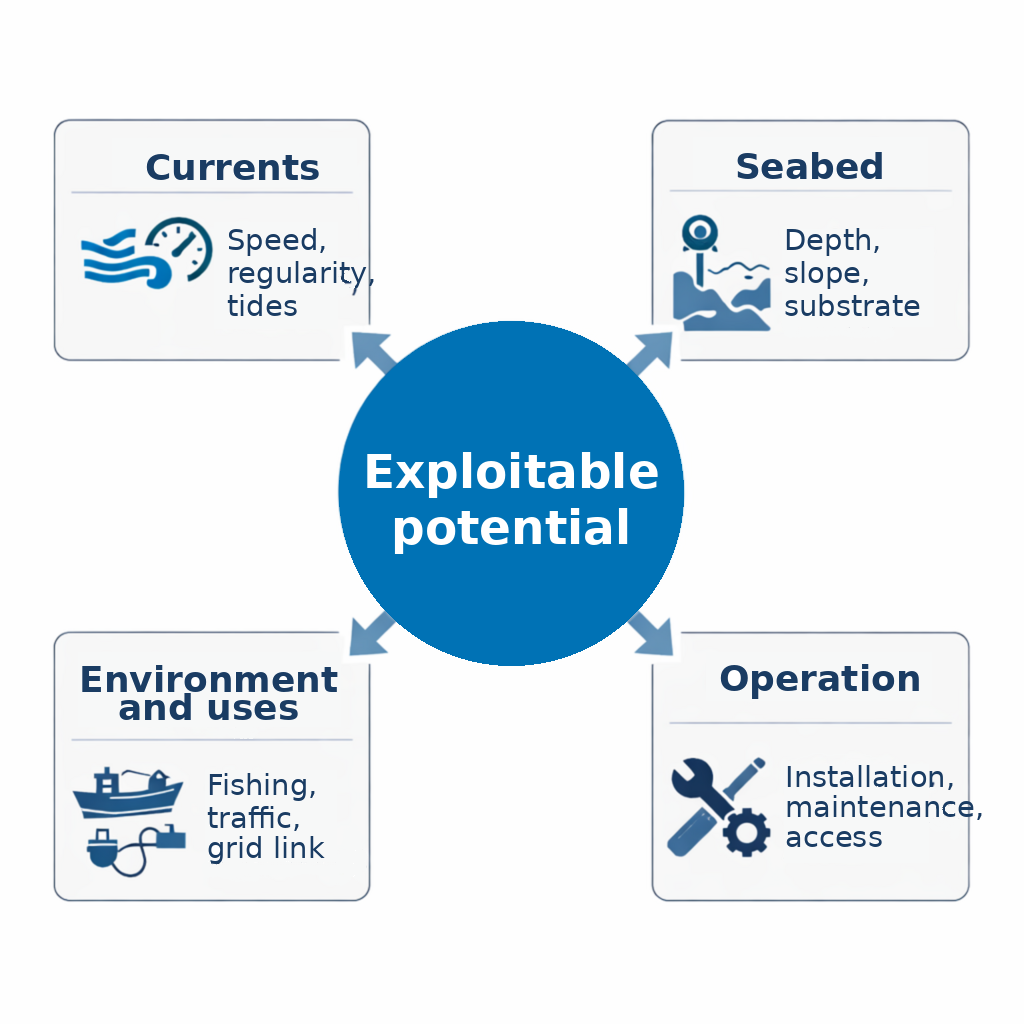
The transition from raw resource to exploitable potential therefore requires a broader analysis than simply reading current-speed or power curves.
7. High-potential areas in the western English Channel and geographical time shift
The western English Channel includes several areas where tidal currents are of particular interest:
- the Raz Blanchard / Alderney Race;
- the Barfleur / Cap Lévi area;
- certain waters around the Channel Islands, in particular the Casquets, the Great Russel and the Little Russel;
- certain sites in the Norman-Breton Gulf.
These areas are not all perfectly synchronised. Peak current speeds do not necessarily occur at the same time.
The coordinated operation of several geographically time-shifted sites could help make aggregated production more regular than production from a single isolated site. This perspective is important because the value of tidal stream energy should not only be assessed at the scale of an individual machine, but also at the scale of a regional group of complementary sites.
This approach will, however, need to be confirmed by detailed hydrodynamic, electrical and economic studies.
8. Limitations of the simulator
The HydreManche® simulator is deliberately simplified.
It does not take into account in detail:
- local turbulence;
- vertical variation of current speed within the water column;
- full wake effects between machines;
- detailed electrical losses;
- actual machine availability;
- maintenance shutdowns;
- site-specific regulatory constraints;
- real installation, operating and decommissioning costs.
The displayed results should therefore be read as orders of magnitude intended to help understand the physical phenomena, not as a contractual production forecast.
Schematic representations and Year mode
The Tide, Day and Typical week modes of the simulator are mainly educational. They make it possible to visualise quickly how a change in current speed affects recoverable power and mechanical loads.
When the site’s maximum current speed is set using a slider, the displayed curve should not be interpreted as the exact reproduction of a measured current. It represents a simplified profile intended to illustrate orders of magnitude.
The Year mode follows a different logic. It aims to provide a representation closer to annual behaviour, based on representative values from a high-current area near the Pointe de Goury / Raz Blanchard.
This mode nevertheless remains simplified. It does not replace a time series of current measurements, complete hydrodynamic modelling or an energy-yield assessment. Its main purpose is to show why annual production cannot be deduced from a simple average current speed, but results from the integration of successive current variations over time.
9. Further reading
The Reference documents page brings together several useful references for further study:
- tidal stream potential;
- tidal currents;
- site constraints;
- power orders of magnitude;
- modelling of tidal turbine arrays;
- the technical and industrial context of the sector.